
One pothole can knock your alignment off. Many drivers in Jacksonville overlook the early warning signs until uneven tire wear forces an expensive replacement. The problem becomes more common if your daily commute includes roads like I-95, I-10, or Beach Boulevard, where rough pavement and potholes are frequent.
Misalignment rarely appears dramatically. Instead, small changes begin to show up over time. Your car may pull slightly to one side. The steering wheel may sit crooked while driving straight. Tire wear may begin appearing along one edge of the tread.
By the time most drivers realize something is wrong, they are already facing $600–$1,200 in premature tire replacement.
In this guide, our tire repair shop experts explain five warning signs that indicate alignment problems and what can happen if you continue driving with misaligned wheels.
Sign #1: Your Car Pulls to One Side
The Symptom
Your car drifts left or right on straight roads. You find yourself constantly correcting the steering to stay in your lane. It becomes most obvious on highways like I-95 or I-10, where you’d expect the car to track straight without constant input.
Why This Happens
Misaligned wheels point in slightly different directions, creating a constant tug through the steering wheel. A single hard pothole at highway speed can shift angles enough to cause this immediately, it doesn’t take repeated impacts.
What Happens If You Ignore It
The pulling won’t fix itself. Your tires begin scrubbing sideways instead of rolling cleanly forward, wearing down unevenly with every mile. Beyond the tire damage, you’re constantly fighting the steering, which creates real fatigue on longer drives and makes emergency maneuvers less predictable when you need them most.
Cost of ignoring: Premature tire replacement and reduced control in emergency situations.
Sign #2: Steering Wheel Is Off-Center When Driving Straight
The Symptom
Your steering wheel sits crooked, tilted slightly left or right, while the car travels straight. Most drivers adapt to this gradually without realizing it. Passengers notice before you do.
Why This Happens
This typically develops from repeated minor impacts rather than one dramatic hit. Routes like Beach Boulevard or Philips Highway, with their stop-and-go traffic and deteriorating pavement, shift suspension geometry slowly until the steering wheel ends up noticeably off-center.
What Happens If You Ignore It
The misalignment causing the crooked wheel also creates rolling resistance the engine has to work against constantly. Fuel efficiency drops quietly over time. Meanwhile one tire edge wears significantly faster than the rest, a tire rated for 60,000 miles may need replacing at 30,000.
Cost of ignoring: Reduced fuel economy and significantly shortened tire life.
Sign #3: Uneven or Rapid Tire Wear
The Symptom
One tire wears faster than the others. The inner or outer edge shows heavy wear while the center tread still looks fine. You often catch it during rotation or routine service, by which point real damage has already been done.
Why This Happens
Misaligned wheels scrub sideways with every rotation instead of rolling straight. Jacksonville’s pavement temperatures reach 120 degrees in summer, which softens tire rubber and dramatically accelerates that scrubbing wear. Different alignment problems create different patterns, inner edge wear, outer edge wear, or a feathered saw-tooth pattern from toe misalignment.
What Happens If You Ignore It
Once uneven wear starts it accelerates quickly. The worn edge has less tread depth to channel water, which raises hydroplaning risk during Jacksonville’s afternoon thunderstorms. In severe cases, the structural integrity of the tire is compromised, increasing blowout risk at highway speeds.
Cost of ignoring: Wet weather traction loss and increased blowout risk.
Sign #4: Steering Wheel Vibrates at Highway Speeds
The Symptom
Your steering wheel vibrates at highway speeds. It feels similar to a balance issue but persists even after balancing. Unlike balance problems that appear at a specific speed and fade above or below it, this vibration tends to continue across multiple speed ranges.
Why This Happens
Misaligned wheels try to travel in slightly different directions simultaneously. At higher speeds that conflict generates a harmonic vibration through the steering system. This often starts after a significant pothole impact and builds over the following few hundred miles.
What Happens If You Ignore It
The forces generating that vibration put constant stress on suspension components, ball joints, tie rod ends, control arm bushings. Parts designed to last 80,000 to 100,000 miles can fail well before that under sustained vibration stress. What starts as a minor nuisance becomes an expensive suspension repair.
Cost of ignoring: Premature suspension component failure costing significantly more than an alignment adjustment.
Sign #5: Your Car Feels Unstable or Hard to Control
The Symptom
The vehicle feels loose or like it’s wandering. You’re making constant small steering corrections to stay in your lane. Lane changes feel less predictable than they used to.
Why This Happens
When multiple alignment angles drift out of specification together, handling degrades noticeably. Jacksonville’s humidity accelerates this, moisture deteriorates rubber bushings and causes corrosion in suspension adjustment points, allowing alignment to shift more easily over time.
What Happens If You Ignore It
This is the sign that carries the most immediate safety risk. Quick swerves and hard braking demand precise vehicle response, a misaligned car may not deliver that, especially on slick roads during a sudden afternoon storm. If worn suspension components are also involved, continued driving worsens the damage until repairs become unavoidable.
Cost of ignoring: Compromised emergency response and accelerating suspension damage.
How Often Do You Actually Need an Alignment?
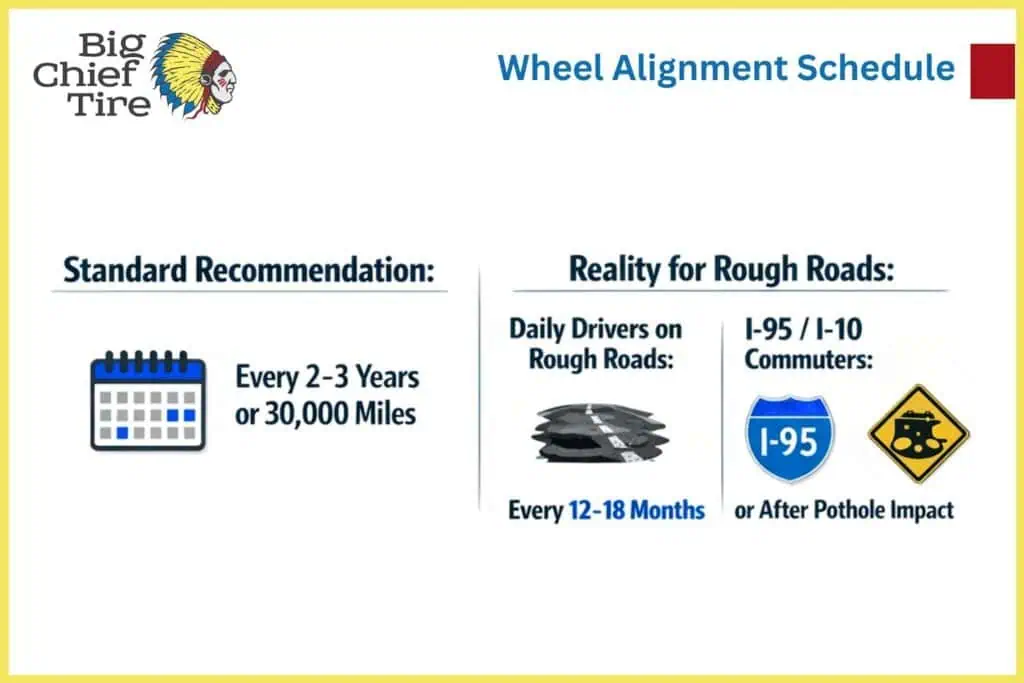
Standard recommendation: Every 2-3 years or 30,000 miles.
Reality for daily drivers on rough roads: Every 12-18 months.
Reality for I-95 or I-10 daily commuters: Every 12 months or after any significant pothole impact.
The difference comes from road conditions. Smooth, well-maintained roads allow longer intervals. Roads with frequent potholes, rough patches, or deteriorating surfaces require more frequent checks.
When to check immediately:
- After hitting a pothole hard enough to feel concerned
- When getting new tires
- When you notice any of the five signs above
- After any accident, even minor fender benders
Cost vs consequence:
- Cost of alignment check/adjustment: starting at $99.99+
- Ignoring alignment issues: $600-1,200 in premature tire replacement
- Plus: Reduced fuel efficiency, safety risks, suspension damage
The math favors regular checks.
Alignment vs Other Issues: What Gets Confused
Alignment vs Suspension Damage:
Both cause pulling, uneven wear, and vibration. The difference is that suspension damage usually includes additional symptoms, clunking noises over bumps, excessive bouncing, or body roll in turns.
After hitting a significant pothole, check both. A hard impact often damages suspension components AND knocks alignment off. Fixing alignment without addressing bent components won’t solve the problem.
Alignment vs Tire Balance:
Balance issues cause vibration at specific speeds, usually 50-70 mph. The car still tracks straight and the steering wheel stays centered.
Misalignment causes pulling, off-center steering, and uneven wear. Vibration from alignment tends to be constant rather than speed-specific.
Reliable tire shops check both during a wheel alignment service since symptoms overlap.
Alignment vs Tire Pressure:
Low tire pressure causes pulling similar to alignment problems. Check tire pressure first, it’s free and takes 2 minutes. If pressure is correct and pulling persists, alignment is likely the issue.
TPMS sensors can be finicky in extreme heat and humidity, so don’t assume the warning light means low pressure. Verify with a gauge.
Get Your Alignment Checked With Tire Experts in Jacksonville
The five signs covered in this blog indicate your alignment needs attention now. The solution is straightforward: get alignment checked when you notice symptoms or after hitting potholes.
Big Chief Tire provides alignment services at all six locations across Jacksonville and Orange Park. Our technicians can identify whether you need alignment, suspension work, or both.
We’ve served the community for over 60 years, providing honest auto repair service recommendations, not just what’s convenient to sell.
Visit any of our tire shops for an alignment check, or schedule your service online.

