

Introduction
Owner’s manuals assume moderate climates when setting oil change intervals. Jacksonville tells a different story. The city averages 90°F from June through September, with pavement temperatures reaching 140°F on summer days. Engine oil chemistry breaks down under sustained heat stress in ways that manufacturer testing doesn’t fully capture.
This guide explains how Jacksonville’s climate affects engine oil and helps drivers make smarter decisions about real-world car oil change intervals, rather than relying on generic recommendations.
The Chemistry Behind Oil Breakdown
Engine oil performs three critical functions: lubrication, heat dissipation, and contaminant suspension. All three degrade faster under sustained high temperatures.
Molecular Breakdown: At temperatures above 250°F (normal operating temperature for most engines) oil molecules begin oxidizing. This process accelerates exponentially as ambient temperatures rise.
Viscosity Changes: Heat causes oil to thin. While this improves flow, it reduces the protective film between metal surfaces. Sustained thinning leads to increased metal-on-metal contact and accelerated wear. The hotter the climate, the faster viscosity breakdown occurs.
Additive Depletion: Modern engine oils contain detergents, dispersants, and anti-wear additives. These compounds deplete 20-30% faster at sustained high temperatures. Once depleted, oil loses its protective properties even if the base oil appears clean. You cannot see additive depletion, it happens internally while the oil still looks acceptable.
Why Manufacturer Intervals Don’t Account for Jacksonville’s Climate
Automakers develop oil change intervals using standardized test cycles that assume average ambient temperatures around 70-75°F, a mix of city and highway driving, seasonal temperature variation, and moderate humidity levels.
However, Jacksonville’s climate does not match these assumptions. High ambient temperatures, elevated humidity, and the absence of seasonal cooling create conditions where oil degradation never truly slows.
Independent oil analysis studies from Florida, Texas, and Arizona confirm this reality. These studies consistently show oil degrading 25-35% faster than in temperate regions. In practical terms, an oil change interval rated for 10,000 miles often performs more like 6,500-7,000 miles in sustained high-heat climates.
The science is clear. Manufacturer intervals require adjustment in high-heat regions. This is not about being overly cautious. It is about responding to measurable chemical breakdown that occurs faster here than in the climates where most manufacturer testing takes place.
How Driving Conditions Accelerate Oil Degradation
Highway Driving: Sustained speeds on I-95, I-295, and JTB generate consistent heat. Combined with Jacksonville’s ambient temperatures, engine oil operates near its thermal limits for extended periods. Highway oil changes should happen 30-35% sooner than manual recommendations. The lack of stop-and-go does not protect the oil, sustained high-speed heat stress degrades it just as effectively.
Stop-and-Go Traffic: Routes like Beach Boulevard and urban Jacksonville create repeated heat cycles. Each acceleration creates a heat spike. Each idle period allows partial cooling. This cycling accelerates oxidation faster than sustained highway heat because the oil never reaches thermal equilibrium. Reduce intervals by 25-30% for primarily stop-and-go driving.
Combined Patterns: I-95 commutes present the worst scenario: high-speed heat generation combined with stop-and-go congestion near Fuller Warren and major interchanges. Oil faces both sustained thermal stress and heat cycling. This combination can reduce effective oil life by 35-40% compared to manufacturer specs.
Short Trips: Engines don’t reach full operating temperature on trips under 10 minutes. This prevents moisture evaporation, leading to oil contamination. In humid climates like Jacksonville, moisture contamination happens faster and accumulates more readily. Vehicles used primarily for short trips need more frequent oil changes despite lower overall mileage.
Synthetic vs Conventional in High Heat – The Performance Gap
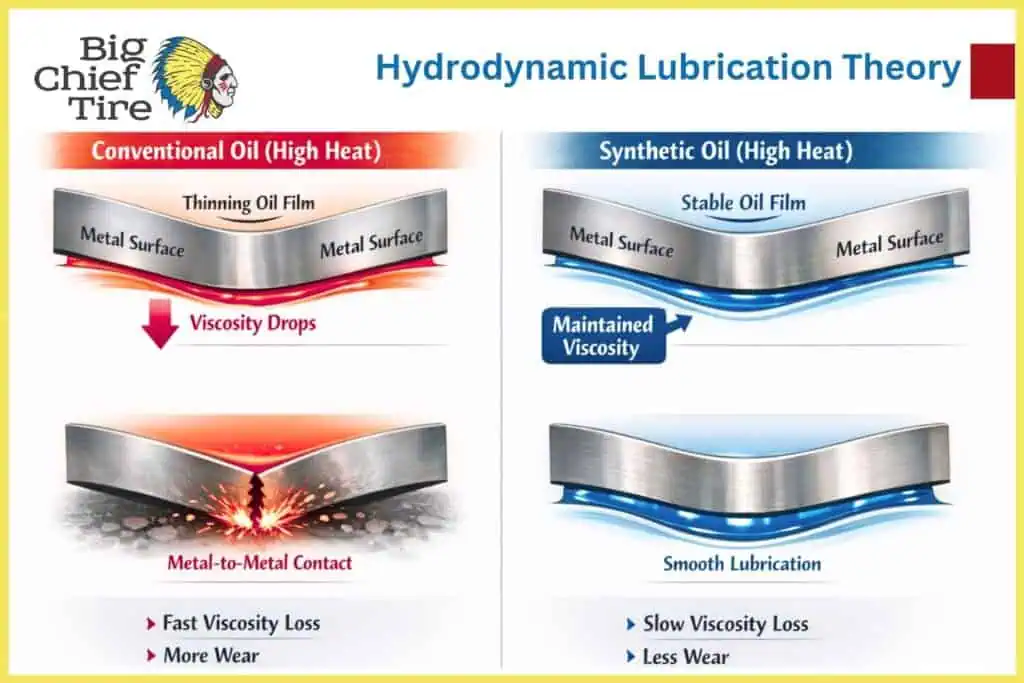
- Conventional Oil Chemistry: Mineral-based oils contain hydrocarbon chains of varying lengths. Under heat stress, these chains break irregularly, causing rapid viscosity loss. In sustained heat, conventional oil’s protective properties decline significantly after 3,000-4,000 miles. The degradation is both faster and less predictable than in moderate climates.
- Synthetic Oil Chemistry: Synthetic oils use uniform molecular structures specifically engineered for thermal stability. Laboratory testing shows synthetic oils maintain viscosity and additive packages 40-50% longer under sustained high temperatures. The molecules resist oxidation more effectively and maintain protective film strength despite heat stress.
The Cost Reality:
Despite higher upfront costs, synthetic oil often costs less per mile in high-heat climates. A conventional oil change at $50 every 3,500 miles costs $0.0143 per mile. A synthetic oil change at $85 every 6,500 miles costs $0.0131 per mile.
Over time, synthetic oil often ends up costing less per mile in climates where heat breaks down conventional oil faster.
When Each Makes Sense:
Use synthetic for daily commuters, highway drivers, vehicles with turbochargers, and European makes requiring specific oil specifications. The heat resistance and extended intervals justify the cost.
Use conventional for low annual mileage vehicles (under 5,000 miles per year), older vehicles with larger engine clearances, or situations where budget constraints require more frequent but less expensive changes.
Research-Based Intervals for Jacksonville
Adjusted Schedules Based on Oil Analysis Data:
If Manufacturer Recommends 10,000 Miles: – Highway driving in Jacksonville: 6,500-7,000 miles – Mixed driving in Jacksonville: 6,000-6,500 miles – Stop-and-go in Jacksonville: 5,500-6,000 miles
If Manufacturer Recommends 7,500 Miles: – Highway driving in Jacksonville: 5,000-5,500 miles – Mixed driving in Jacksonville: 4,500-5,000 miles – Stop-and-go in Jacksonville: 4,000-4,500 miles
If Manufacturer Recommends 5,000 Miles: – Highway driving in Jacksonville: 3,500-4,000 miles – Mixed driving in Jacksonville: 3,000-3,500 miles – Stop-and-go in Jacksonville: 2,500-3,000 miles
Time-Based Changes: Regardless of mileage, oil degrades from heat and humidity exposure alone. For low-mileage vehicles, change synthetic oil every 12 months and conventional oil every 6-8 months. Oil sitting in a hot engine deteriorates even when the vehicle is not being driven.
Oil Life Monitoring Systems: Modern vehicles calculate oil life using algorithms based on engine temperature, RPM patterns, and mileage. However, these systems use default parameters not calibrated for sustained high heat. Treat monitor readings as maximum intervals and reduce by 20-25% in Jacksonville conditions. When the monitor shows 20% oil life remaining, that is likely closer to actual end of life in this climate.
Warning Signs of Heat-Degraded Oil
Visual Inspection: Fresh oil appears amber or honey-colored and translucent. Pull the dipstick and wipe oil on a white paper towel. If you cannot see through it or it appears black, the oil has oxidized significantly. This is the simplest and most reliable test for oil condition.
Audible Signs: Degraded oil loses viscosity and cannot maintain a proper lubrication film. Listen for increased valve train noise that sounds like ticking, louder engine operation overall, or rough idle quality. These sounds indicate the oil is no longer protecting moving parts effectively.
Performance Changes: Watch for decreased fuel economy as the engine works harder with degraded oil, reduced throttle response, or the check engine light appearing, often related to oil pressure issues. These performance changes happen gradually but become noticeable as oil protection fails.
Smell Test: Severely degraded oil smells burnt or acrid. Fresh oil has a mild petroleum smell. A strong burnt odor indicates oxidation and potential contamination from combustion byproducts entering the oil.
Protect Your Engine with the Right Oil Change Schedule at Big Chief Tire
Following the manufacturer’s oil change intervals in Jacksonville means running your engine on degraded oil for thousands of miles. The 30% faster breakdown rate documented in this guide is not theoretical; it is measurable chemical degradation happening inside your engine right now.
The solution is straightforward. Reduce your oil change interval by 25-35%, or schedule your oil change service with us and let our team guide you on the right interval for Jacksonville’s climate.
Big Chief Tire has been serving the Jacksonville community with complete auto repair services for over 60 years. Our technicians are highly recognized for providing the right advice for all your service needs, not just selling what is convenient.
Visit any of our six convenient BCT locations across Jacksonville and Orange Park, or schedule your service online today.
Frequently Asked Questions
Why does heat destroy engine oil faster than cold?
Heat accelerates oxidation, in which oxygen molecules bond with oil molecules, breaking down the oil’s structure. This is an exponential process; every 18°F increase in temperature doubles the oxidation rate. Jacksonville’s sustained heat means this process never slows down seasonally as it does in temperate climates. The chemical reaction that damages your oil happens continuously for most of the year.
Should I follow my car’s oil life monitoring system?
Use it as a maximum limit, not a precise guide. These systems were not calibrated for Jacksonville’s climate. When the monitor says 20% oil life remaining, consider that closer to the end of effective life in this heat. Changing oil when the monitor shows 30-40% remaining provides a better safety margin in sustained high-heat conditions.
Do turbocharged engines need even shorter intervals here?
Yes. Turbochargers operate at extremely high temperatures, often exceeding 1,000°F, and rely on clean oil for bearing lubrication. In high-heat climates, reduce turbo vehicle intervals by an additional 10-15% beyond standard heat adjustments. Turbocharged engines already stress oil more than naturally aspirated engines. Adding Jacksonville heat compounds that stress significantly.
Can I extend intervals with premium synthetic oil?
Premium full-synthetic oils with high-temperature ratings resist breakdown better. You might extend intervals by 10-15% compared to standard synthetic, but do not exceed the manufacturer’s maximums. Heat still degrades even the best oils, just more slowly. Premium synthetic buys some additional protection but does not eliminate the climate impact on oil chemistry.

