
Introducing:
When your steering wheel starts to tremble at highway speeds or the car hums with a faint rhythmic vibration, the problem often lies deeper than tire wear. What you are feeling is imbalance, the uneven distribution of weight around your wheel and tire assembly.
It may seem minor, but at 60 miles per hour, that small offset can generate enough centrifugal force to shake an entire suspension system.
For our tire repair shop technicians in Jacksonville, balancing is not just about a comfortable ride. It is about precision engineering, ensuring every tire and wheel rotate with uniform force, protecting your suspension, steering, and fuel efficiency over time.
Understanding Tire Balance and Imbalance
Each tire and wheel should act as one perfectly round mass, but even a few grams of uneven weight distribution can create imbalance. As the wheel spins, the heavier spot pulls outward with increasing force (force grows proportionally to the square of speed). At highway velocity, this produces a pulsing vibration that travels through the steering column, seat, and frame.
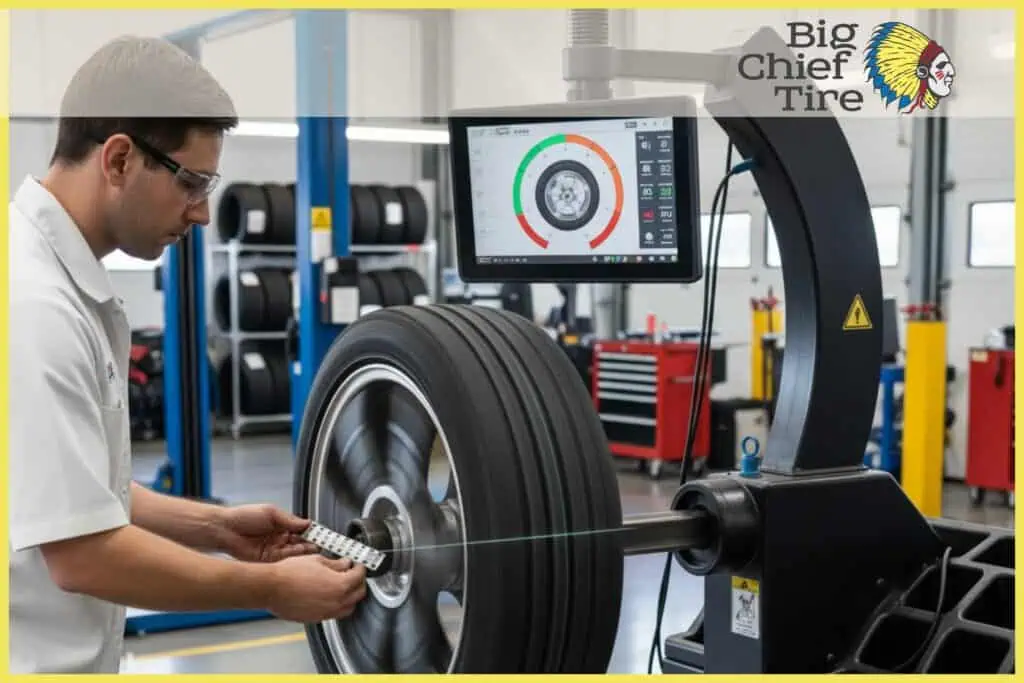
To correct it, technicians use a computerized dynamic balancer. The tire is mounted and spun while sensors detect the precise location and magnitude of imbalance. Small counterweights (sometimes as light as a quarter of an ounce) are then attached to the wheel rim to restore equilibrium.
This process sounds simple, but its precision is mechanical science. A tire that is out of balance by just one ounce at the tread can exert over 30 pounds of pull at 60 mph. Left unchecked, that constant stress fatigues bearings, shocks, and tie rods, gradually deforming components designed for tight tolerances.
Resonance: The Hidden Amplifier
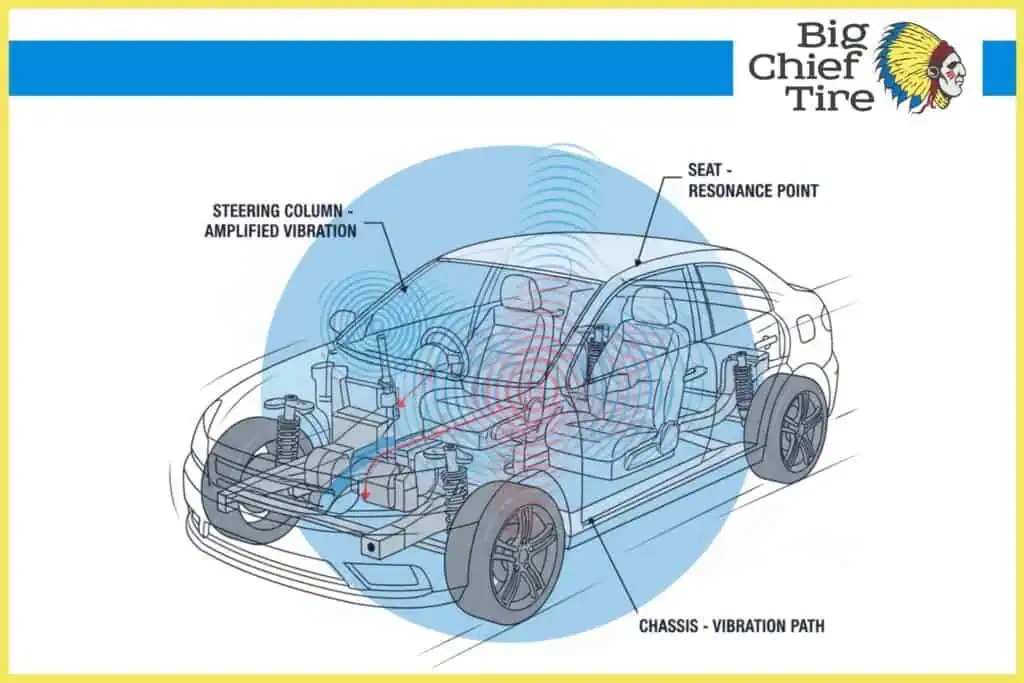
Most drivers do not realize that vibration from imbalance can “sync” with the suspension’s natural frequency, a condition called resonant coupling. When this happens, the vibration multiplies instead of fading.
At that point, the shaking you feel is not from a rough road but from physics. The suspension, instead of absorbing energy, is echoing it back through the chassis. That is when steering becomes harder to control, mirrors start to blur, and fatigue damage accelerates on bushings and wheel hubs.
Routine balancing prevents the imbalance from ever reaching that resonance zone. This is one reason why vibration tends to appear first around 55–65 mph and fade at lower speeds, the resonance range for most vehicles.
Heat, Wear, and Rolling Resistance
Imbalanced tires also generate concentrated heat. When one part of a tread consistently bears more load, it flexes harder, producing localized friction and temperature rise. The result is uneven rubber hardening, cupping, and accelerated tread degradation.
From an energy perspective, imbalance increases rolling resistance, the effort required for the tire to maintain rotation. According to studies on fuel efficiency from the U.S. Department of Energy, misalignment and imbalance together can lower gas mileage by as much as 10 percent. Every ounce of additional resistance means the engine must supply more torque, consuming extra fuel mile after mile.
That is why balancing plays an indirect but measurable role in fuel economy and tire longevity. It keeps mechanical energy focused on forward motion rather than wasted vibration.
Diagnosing Imbalance Before It Gets Worse
Signs of imbalance start subtly and build over time:
- A steering wheel that trembles between 50–70 mph
- A seat or floorboard vibration that comes and goes
- Uneven or scalloped tread wear, especially on front tires
- A low-frequency droning sound at consistent speeds
- Loosened wheel weights or a change in ride comfort after tire rotation
A quick spin test at a professional tire place near me confirms imbalance within seconds. What feels like a suspension issue or road roughness often turns out to be a matter of a few grams of misplaced weight.
Precision Over Guesswork
Balancing is not a DIY procedure. It demands calibrated machinery capable of detecting vibration amplitude in fractions of an ounce. Professional mechanics also account for:
- Match mounting: aligning the tire’s low spot with the wheel’s high spot to minimize total runout.
- Dynamic vs. static balancing: using dual-plane correction for both lateral and radial forces.
- Torque accuracy: re-tightening wheels to manufacturer specifications after adding weights.
This precision prevents secondary problems such as rim damage or uneven pressure at the hub. The process also identifies bent wheels or separated belts that balancing alone cannot fix, saving you from deeper mechanical failures later.
Florida Driving Conditions and Balance Fatigue
Jacksonville’s roads are known for expansion joints, heat, and humidity, three conditions that shorten balance intervals. Heat expands air inside the tire, humidity corrodes adhesive wheel weights, and minor pothole impacts slowly knock balance out of specification.
For local drivers, it is smart to combine balancing with every tire rotation or oil change, roughly every 6,000 miles. Vehicles with larger wheels or low-profile tires may need checks even sooner because smaller sidewalls transmit more vibration into the cabin.
Tire Balancing vs. Wheel Alignment
Many drivers assume tire balancing and wheel alignment are interchangeable, after all, both improve ride comfort and tire life. But technically, they address completely different problems in how your tires interact with the road.
- Balancing ensures that each tire spins evenly around its axis
- Alignment ensures that all tires point and contact the road correctly
A car with perfect alignment can still vibrate if unbalanced, while a balanced tire can still wear unevenly if misaligned. Together, they form the engineering foundation of reliable tire care and maintenance.
Big Chief Tire – Jacksonville’s Trusted Tire Place for Precision Balancing

Tire balancing is both science and craftsmanship. It requires trained eyes, calibrated machines, and an understanding of how small mechanical forces translate into driver comfort and vehicle health.
At Big Chief Tire, our technicians combine decades of experience with advanced balancing systems to ensure every tire leaves perfectly tuned. We serve Jacksonville drivers with complete auto and tire services like balancing, alignment, rotation, and inspections that extend tread life and protect fuel efficiency.
Visit your nearest Big Chief Tire repair shop in Westside, Southside, Northside, Mandarin, Blanding, or Orange Park to keep your car stable, efficient, and vibration-free on every drive. Book your tire balancing service today. Experience precision you can feel and safety you can trust.
