
Introduction
Choosing new tires in Jacksonville means dealing with conditions that national tire guides rarely account for. Those guides discuss all-season versus summer tires and manufacturer ratings. What they do not explain is how tires actually perform when temperatures sit around 95 degrees with 75 percent humidity most of the year, when afternoon thunderstorms drop an inch of rain in twenty minutes, or when you are sitting in I-95 traffic day after day.
Big Chief Tire has sold tires in Jacksonville since 1961. Across six decades and six locations, we have tracked which tires last here, which fail early, and which consistently perform best in Northeast Florida conditions. This guide reflects what that experience has taught us.
Why Jacksonville Wears Out Tires Differently
Jacksonville averages close to 90°F from June through September, with pavement temperatures reaching 140°F on summer afternoons. Unlike regions with real winters, tires here do not get a break from heat stress. They operate in high temperatures for most of the year, every year.
- Thermal Aging: Heat affects tires in specific ways. Rubber compounds soften in constant heat and wear faster. Heat also accelerates rubber aging, even on vehicles with low mileage. We regularly see five-year-old cars with under 30,000 miles that have acceptable tread but are cracking and unsafe because the heat has aged them out.
- The Humidity/Pressure Loop: Humidity compounds the problem. Jacksonville’s humidity typically ranges from 70 to 80 percent most of the year. When brief cool spells arrive and temperatures drop into the 40s overnight, tire pressure drops by two to three PSI. The TPMS light comes on. In many cases, there is no leak. It is simply a temperature change, but pressure still needs to be checked and adjusted.
- Flash Flooding: Rainfall is the final factor. Jacksonville receives about 51 inches of rain annually, with August alone bringing nearly eight inches. What matters for tires is not just how much rain falls, but how it arrives. Sudden afternoon storms overwhelm drainage systems quickly. We have seen vehicles hydroplane on tires with 6/32 tread depth because the tread design could not evacuate water fast enough for Jacksonville flash rainfall.
How Jacksonville Traffic Wears Tires
The I-95 corridor creates some of the harshest tire wear patterns in the city. Sustained highway speeds generate heat, followed by stop-and-go congestion near the Fuller Warren Bridge and other major interchanges. That combination wears tires faster than pure highway or pure city driving.
Drivers with daily commutes on that route typically see mileage 15 to 20 percent lower. A tire rated for 50,000 miles often delivers closer to 40,000 to 42,000 miles on an I-95 commuter. This is not tire failure. It is the reality of that corridor.
I-295 presents a different challenge. Long curves mean outside tires carry more load than inside tires. We see uneven wear, especially on Front Wheel Drive vehicles that move heavily on I-295. For those drivers, tire rotation every 5,000 miles is far more effective than stretching intervals to 7,500 or 10,000 miles.
JTB adds another layer. Smooth pavement encourages higher speeds. Higher speeds mean more heat. More heat accelerates wear and aging.
Beach Boulevard, on the other hand, is a constant stop-and-go, which tends to wear the center tread faster than the shoulders.
What 60 Years of Selling Tires Here Has Taught Us
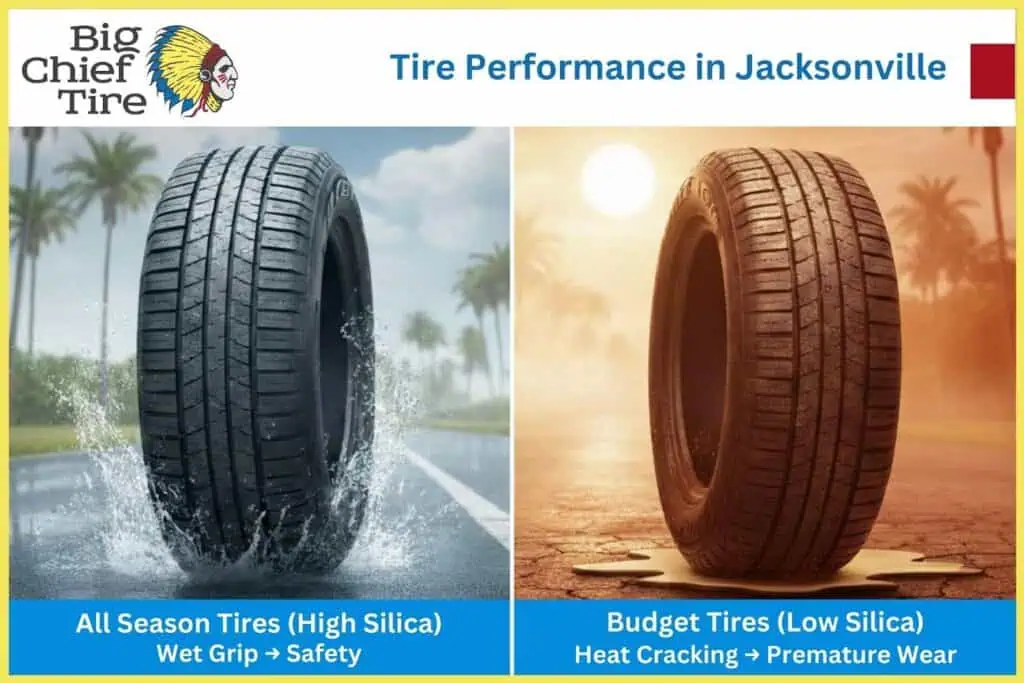
Tires with high silica content in the rubber compound consistently outperform traditional compounds in Jacksonville. Silica helps rubber remain stable at high temperatures while improving wet traction. Many premium tire lines now rely on silica-enhanced compounds specifically for warm, wet climates like ours.
Winter tire compounds tell the opposite story. Designed to remain soft in freezing temperatures, they become excessively soft in Jacksonville’s heat. We have seen winter tires wear out in as little as 20,000 miles because the tread simply melts away.
Tread design matters just as much. Tires with wide circumferential channels and strong lateral grooves handle sudden rain far better than shallow or minimally grooved designs. Some tires feel excellent in dry conditions, but hydroplane dangerously the moment an afternoon storm hits.
Mileage warranties also need context. Manufacturers assume moderate temperatures and mixed driving. In Jacksonville, a 60,000-mile tire typically delivers 45,000 to 50,000 miles. That is not an early failure. It is climate reality.
Budget tires show even larger gaps. A 40,000-mile budget tire often delivers only 25,000 to 30,000 miles here because the compounds cannot tolerate sustained heat.
Recommendations Based on What Actually Works
Premium Tires
Premium touring tires consistently deliver the best results in Jacksonville. These tires often reach 50,000 miles or more, even with daily I-95 commuting. Wet traction remains strong throughout their lifespan, and heat aging is slower. Pricing typically ranges from $150 to $250 per tire. When the cost per mile is considered, premium tires usually cost less in the long run.
Mid Range Tires
Mid-range tires from established manufacturers perform well for many Jacksonville drivers. With proper rotation and pressure maintenance, 40,000 to 45,000 miles is realistic. Pricing usually ranges from $100 to $150 per tire and works well for drivers covering 10,000 to 12,000 miles annually.
Budget Tires
Budget tires typically cost $60 to $90 per tire. In Jacksonville conditions, the realistic lifespan is 25,000 to 35,000 miles. These tires make sense for low-mileage vehicles or cars that will be replaced soon. They do not make sense for daily highway commuters.
Tires to Avoid in Jacksonville
Winter and Snow Tires
Winter tires are designed for driving on snow, ice, and in freezing temperatures. In the Jacksonville heat, they wear extremely quickly and perform poorly in the rain. Even the coldest winter days here do not justify winter tire compounds.
Bottom Tier Budget Brands
The cheapest tires on the market rarely survive Jacksonville conditions. Poor heat resistance and weak wet traction often lead to failure at 15,000 to 20,000 miles. The small upfront savings disappear quickly when replacements are needed years earlier than expected.
What Your Part of Jacksonville Does to Tires
Beaches Area
Salt air causes corrosion where the tire bead seals against the wheel. This leads to slow leaks that feel like tire problems but are actually wheel issues. For beach area vehicles, wheel inspection during rotation is critical. Beach Boulevard traffic also accelerates center tread wear due to constant stop-and-go driving.
Westside
I-10 between I-295 and downtown sees heavy commercial traffic that damages road surfaces. Westside vehicles experience more punctures, sidewall damage, and vibration-related wear. Daily I-10 commuters should expect 20 to 30 percent less mileage and inspect tires monthly for debris.
Southside and Mandarin
Long commutes on JTB and 295 create continuous heat cycles. Many Mandarin drivers cover over 15,000 highway miles per year just by commuting. Tires may look fine, but feel different due to internal heat aging. Replacement at five years is often advisable, even if the tread depth is well maintained.
Northside
Driving patterns vary widely, from I-95 commuting to local industrial routes. Versatile all-season tires generally perform best here, especially for drivers who keep vehicles long term.
When to Replace Tires in Jacksonville
The legal minimum tread depth is 2/32, but that is unsafe for Jacksonville rain. At 4/32, wet traction drops noticeably. At 3/32, the risk of hydroplaning increases sharply. For most drivers, replacement at 4/32 is the safest choice. For a deeper dive, read our tread depth guide.
Tire manufacturers often recommend replacement at six years. In Jacksonville, heat and UV exposure, five years is a more realistic maximum. Heat and humidity accelerate internal rubber breakdown even when the tread appears usable.
After any hard pothole impact, inspect the tires for sidewall bulges or changes in vibration. If the hit felt severe, professional tire inspection is wise even if no damage is immediately visible.
Make Your Tire Buying Journey Easy With Big Chief Tire Experts
Finding the right tires near me is easier when you have options and guidance that reflect real driving conditions, not generic recommendations. Having access to multiple trusted brands allows drivers to choose tires that fit their vehicle, budget, and how they actually use the car.
Big Chief Tire carries a wide range of trusted tire brands and uses local Jacksonville experience to help narrow those choices to the right tire type for your specific needs. Heat, rain, commute routes, and mileage all factor into those recommendations.
If you need help selecting the right tires, simply visit any of our locations near you. Our team will walk you through the options and recommend the best option for your vehicle and local driving conditions.
Frequently Asked Questions
How long do tires really last in Jacksonville?
In Jacksonville’s heat, a 60,000-mile warranty tire typically delivers 45,000-50,000 miles. Budget tires often last only 25,000-30,000 miles. Heat and humidity accelerate wear, so expect 15-20% less mileage than the warranty rating.
When should I replace my tires in Jacksonville – 2/32” or 4/32” tread?
Replace at 4/32” tread depth, not the legal minimum of 2/32”. At 4/32”, wet traction drops noticeably in heavy rain. At 3/32”, hydroplaning risk increases sharply. Jacksonville’s sudden thunderstorms make deeper tread critical for safety.
Why do my tires age out before the tread wears down?
Jacksonville’s sustained heat and UV exposure age tire rubber internally, even when the tread looks good. We recommend replacement at 5 years, regardless of tread depth, rather than the typical 6-year guideline. Heat and humidity accelerate rubber breakdown that you cannot see.
Do I need special tires for Jacksonville weather?
You need all-season tires with silica-enhanced compounds and aggressive water evacuation channels. These maintain flexibility in heat while improving wet traction. Avoid winter tires (wear out in 20,000 miles here) and cheap budget brands that cannot handle sustained heat.
Should I rotate tires every 5,000 or 7,500 miles in Jacksonville?
Rotate every 5,000 miles in Jacksonville heat, not 7,500-10,000. Heat accelerates uneven wear, especially for I-295 commuters and front-wheel-drive vehicles. More frequent rotation evens out heat exposure and extends total tire life.
Are premium tires worth the extra cost in Jacksonville?
Yes. Premium tires often cost less per mile in Jacksonville. A $200 tire lasting 55,000 miles costs less than a $100 tire dying at 30,000 miles. Premium tires also maintain wet traction longer and resist heat aging better, both of which are critical here.
