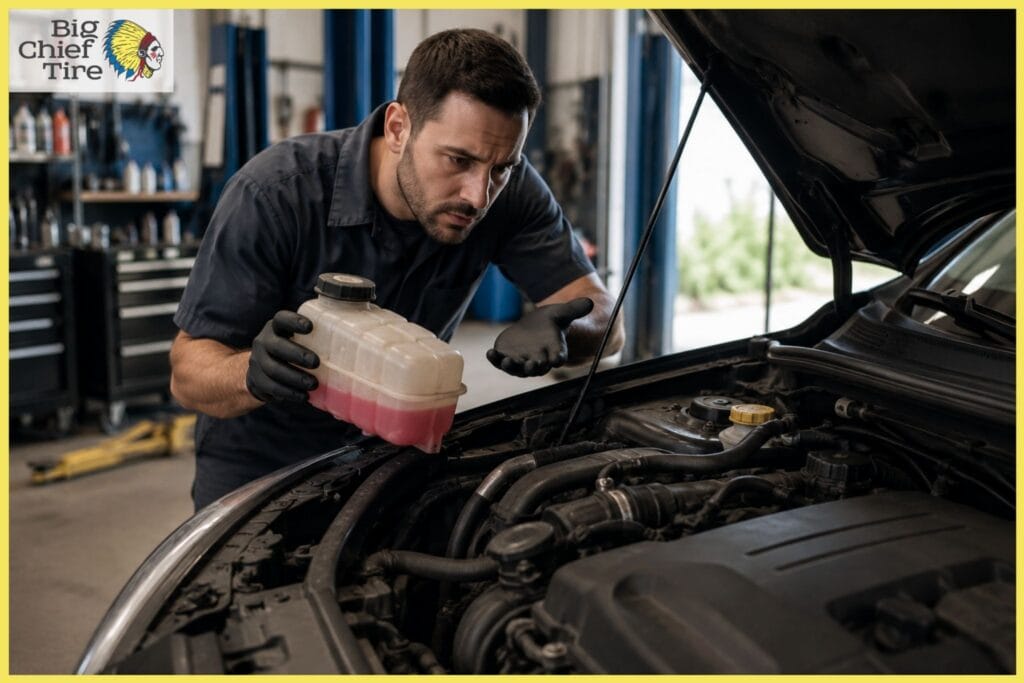
You’re losing coolant, and there’s no puddle to explain it. Top it off, and it’s low again within a few weeks- nothing in the driveway, nothing in the garage, nothing under the car at all.
If you’ve been chasing a leak you can’t find, the leak might not be where you’re looking. It is the kind of cooling system problem our Westside mechanics see because the source is not always visible from underneath the vehicle.
Here’s how to tell which type of coolant loss you may be dealing with, and why the difference matters.
Two Different Problems, Same Symptom
A dropping coolant level with no obvious puddle generally points in one of two directions: an external leak that’s difficult to see, or an internal leak where coolant is entering the engine.
Hidden External Leak
Small external leaks can be especially difficult to spot because they may appear only when the cooling system is hot and pressurized. Coolant can escape onto a hot component and evaporate before enough reaches the ground to leave a puddle. A worn radiator cap, a hairline crack in the overflow reservoir, or a weak hose connection can all leak this way without ever showing up as a wet spot underneath the car.
Internal Coolant Leak
A failing head gasket, or in some engines a leaking intake manifold gasket, lets coolant seep into the combustion chamber or mix with engine oil instead of leaking outside the engine at all. Coolant entering the combustion chamber can exit the engine as vapor through the exhaust, while coolant entering the oil system may contaminate the engine oil. Either way, there’s nothing on the ground to find because the coolant never made it to the ground.
If you’re seeing an actual puddle instead of just a dropping level, that’s a different, more straightforward problem, our color-coded fluid leak guide covers what each color means and how urgent it is.
How to Tell Which One You’re Dealing With
A hidden external leak may cause the coolant level to fall gradually without obvious changes in how the engine runs. You may notice dried coolant residue near a hose or fitting, or a faint sweet smell after driving. A cooling system pressure test can often help locate the source.
Possible warning signs of an internal coolant leak include persistent white exhaust after the engine is fully warm, a sweet exhaust smell, unexplained misfires, overheating, or oil that appears milky or discolored on the dipstick. Worth noting, condensation can cause white vapor at startup on its own, so white exhaust alone doesn’t confirm a head gasket problem; it’s one signal among several.
Why Just Topping It Off Doesn’t Fix Anything
Adding coolant when the level drops feels like the responsible thing to do, and it buys time either way. But it doesn’t address either underlying cause. This is exactly the kind of issue regular preventive maintenance can help catch early. A cooling system inspection and pressure test can reveal hidden external leaks, while additional testing may be needed when an internal leak is suspected.
Skip that step, and a slowly dropping coolant level can allow the problem to progress until the engine begins overheating. Prolonged idling or stop-and-go driving doesn’t cause the underlying leak, but it gives an already compromised cooling system less margin when temperatures rise, making the same problem harder on the engine.
Get It Diagnosed at Big Chief Tire on Normandy Boulevard
The right way to find the source of disappearing coolant is to diagnose the cooling system, not to repeatedly top it off. Depending on the symptoms, this may include a pressure test, inspection for hidden external leaks, or testing for combustion gases in the coolant.
At Big Chief Tire, our Westside mechanics can diagnose unexplained coolant loss before a small cooling system problem causes overheating. If the temperature gauge is rising or the engine is already overheating, stop driving and have the vehicle inspected rather than trying to make it to the shop.
Visit our tire shop on Normandy Blvd at 5444 Normandy Blvd, Jacksonville, FL 32205, call 904-872-6609, or schedule your cooling system inspection online today.